MODULESView All
Address Cleanse / Sort
Archive Assistant
Barcode, OMR, Text
Book Block
Concatenation
Data Import/Export
Delete / Replace Pages
Finishing Commands
Insert Pages / Messages
Mask Information
Merge
N to 1
Overlay / Underlay
Scale / Shift
Segment / Split
2-Up

Address Cleansing/Sorting

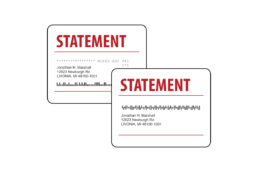
Rubika™ is able to extract content from documents to be fed into address cleansing and sorting software. The address cleansing and sorting software cleanses the addresses and the updated information is re-imported into Rubika. Rubika updates the document with the corrected address information and separates undeliverables out of the mailing. The sub-documents are sorted in postal (zip) order using external business logic based on the extracted information. Common business process improvements that this feature offers include:

  • Data cleansing and sorting can be done downstream at run-time
  • Cleansing and sorting can be done on formatted content without needing to access the original composition software or database
  • Supports co-mingling of documents into single postal run
  • Can be staged with postal sorting
  • Supports reverse order of print
  • Enables great potential for postal savings
  • Increases delivery success

Archive Assistant

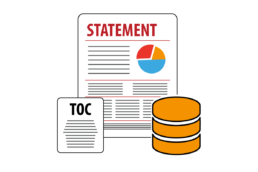
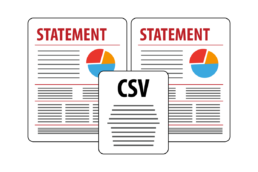
Rubika™ is able to create a "table of contents" for files to facilitate adding them to an archive repository. This table of contents is a separate text file (commonly CSV) that associates the file, a range of pages in the file, and fields containing indices and other text describing the content of the file. Many legacy archives do not provide a robust method to isolate and index content of external files and Rubika's Archive Assistant can facilitate this process.
Barcode, OMR, Text

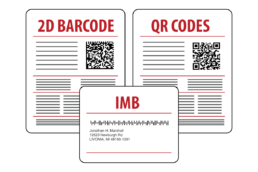
Rubika™ produces content to support inserter controls (barcodes and OMR) as well as text for addressing letters or providing other human readable messages.

  • Based on document content and page counts, Rubika applies:
    • OMR marks
    • Datamatrix barcodes
    • Text (marketing messages, sequence numbers, etc)
    • Linear barcodes, including:
      • Intelligent Mail Barcode (IMB)
      • 3of9
      • Interleaved 2of5
      • Interleaved 2of5 Mod10
      • Postnet
      • USPS Postnet
      • Code128
      • Royal Mail 4-state
      • PDF417

Book Block

Rubika™ is able to arrange duplicates of a single page image in an n-up fashion on an output sheet using the Book Block Module. Each output sheet contains n duplicates of the same page image. This Module is typically used to support print on demand (POD) applications, and its output can be used with continuous feed, cut sheet, and wide-platen printers. The printed output is then manipulated by finishing devices; for example, it might be cut and bound into a book.

Finishing Commands

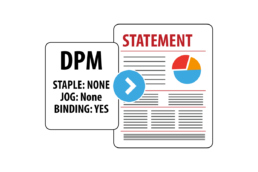
Rubika™ is able to add finishing commands to files based on page numbers or indexed page content. The output can be printed on PostScript, IPDS or Metacode printers by the Solimar® Print Director™.
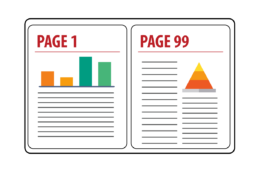
Common business process improvements that this feature offers include:

  • Adding finishing to files that require media or plex selection
  • Offsetting concatenated content

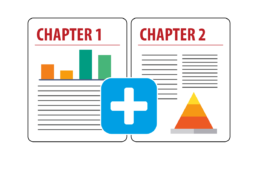
Concatenation

Rubika™ is able to append multiple data files together. Applications for this capability include:

  • Assembling multiple chapters of a manual
  • Producing larger files from many small reports to improve printing efficiency
  • Collating files containing information common to a particular set of criteria

When concatenating, Rubika does not change the order of the content in the files, it simply appends the files together in a logical order. Rubika processes all files matching the File Mask in the Input Directory in one process step.

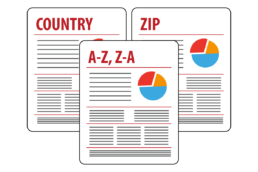
Rubika concatenates files in the following orders: alphabetical (A to Z, 0 to 9), FIFO (First In First Out), or LIFO (Last In First Out).

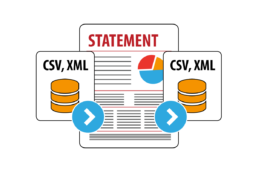
Data Import/Export

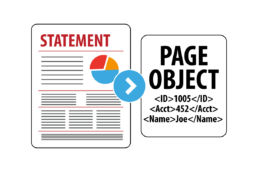
Rubika is able to export content from documents to feed external data manipulation routines and then import the updated content for use with subsequent Rubika Modules. The Import/Export Module provides great flexibility in that the exported CSV data can be modified by any external routine clients define to meet their workflow requirements.

Examples of common business process improvements that this module enables include:

  • Sort data based user-defined routines
    • Based on zip codes, delivery points, piece weights, alphanumerical
  • Insert additional content and flag records to control downstream processing rules
    • Deletion of records/pages
    • Segmenting output
    • Insert PDF codes to link to external files, video, web links, marketing messages
  • Integrate with external databases
    • Update external databases with indexed document information
    • Update and insert Rubika variables with external database content
    • Facilitate interaction with ADF workflow processes

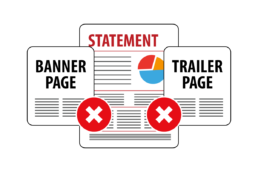
Delete / Replace Pages

Rubika™ is able to remove or replace pages from reports. Some common uses for this are:

  • Deleting banner and/or trailer pages from reports that don't need to be printed or saved with the documents
  • Replacing a page containing outdated terms and conditions with a new page containing revised text

Finishing Commands

Rubika™ is able to add finishing commands to files based on page numbers or indexed page content. The output can be printed on PostScript, IPDS or Metacode printers by the Solimar® Print Director™.

Common business process improvements that this feature offers include:

  • Adding finishing to files that require media or plex selection
  • Offsetting concatenated content

Imposition

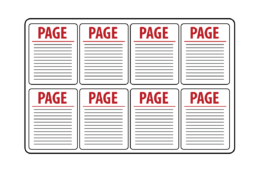
Rubika™ is able to apply imposition to a document by tiling pages of a particular size (commonly US Letter or A4) onto larger sheets (commonly ledger or A3) to make booklets. It does not require that all of the pages in the document be imposed, but provides a method for designating a set and sequence for the tiling.

Rubika can impose pages for manuals and other print-on-demand documents. In a manual, for example, each chapter could be treated as a report for the purpose of setting up the imposition process.

Insert Pages / Messages

Rubika™ is able to add sheets to documents dynamically. Reasons for adding sheets to a document include:

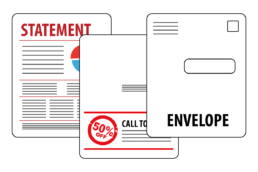
  • Creating address pages for larger 'flat' envelopes
  • Adding marketing messages or legal terms and conditions
  • Adding tabs to manuals

Mask Information

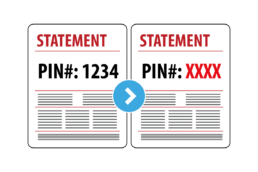
Rubika™ supports the placement of opaque rectangular regions on a page. Commonly, Rubika uses a white rectangle to conceal barcodes or OMR that might not be suitable for a particular inserter. Rubika can then apply new barcodes, OMR, and sequence numbers on top of the opaqued region.

Masking can be applied to visually hide confidential or sensitive information such as Social Security Numbers and PIN or account numbers. Rubika can then apply i.e. XXX-XX-XXXX on top of the opaqued region.

Merge

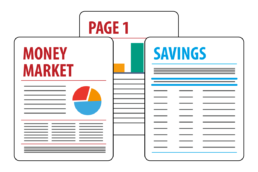
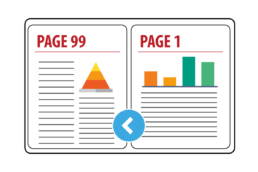
Rubika™ can merge files and sub documents together based on indexed content. Rubika's file merging is not simply concatenating files, but is grouping related information from multiple documents together to create a consolidated document. Typically, users start with a "master" file and one or more "detail" files containing content they would like to merge into the master. Content within the master file, such as an account number, would associate content among the files. The merge step extracts pages containing matching account numbers from the detail files and weaves them into a new version of the master document adjacent to each other. This module can eliminate manual collation tasks and reduce mailing costs by consolidating content into one envelope. Some business process improvements are:
  • Householding, consolidated mailings
  • Document assembly / automated collating
  • Inserting variable marketing messages
  • Reduced manual labor
  • Reduce mailing costs

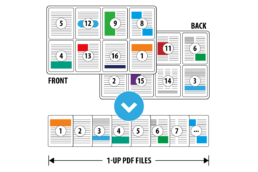
N to 1

Rubika™ is able to reverse the order of the output pages where the output is delivered in descending order-the last page is first in the stack, and the first page is last using the N to 1 Module. This is typically used to accommodate finishing equipment such as an inserter or a stitching device.

  • Reverses the pages of the entire file to output pages in descending order
  • Reverses pages within individual subdocuments, statements or reports while maintaining the overall order of each sub-document in the file.

Overlay / Underlay

Rubika™ can conditionally insert form (opaque) overlays or (non-opaque) underlays or watermarks to pages of documents based on variable index information. The workflow process improvements for this are:

  • Masking confidential content
  • Replicating pre-printed stock so reprinted or viewed reports look like original printed copies
  • Adding conditional marketing and legal messages
  • Fill white space with content
  • Adding variable logos and pictures

Scale / Shift

Rubika™ is able to adjust the size and position of page images by scaling, shifting, and/or rotating page images in the data to meet various formatting requirements. Applications for this capability include:

  • Shrinking and offsetting the page images to create room for barcodes or insertion device control codes close to the edge of the output to prevent overprinting or other interference with existing data.
  • Shifting, offsetting or shingling the page data in the input document in an alternating fashion to meet binding requirements.
  • Scaling (bigger or smaller) and shifting content around a page to fit the physical media.
  • Rotating certain page images from their original orientation.

Segment / Split

Rubika™ is able to break files into multiple smaller ones using two methods:

  • Segmenting
  • Splitting

When segmenting, Rubika separates a file by extracting "reports", indexed sub-documents, based on:

  • The number of sheets
  • The postal delivery (zip) code for each report

Segmenting extracts and groups reports with similar sheet totals or zip codes. Adjacent reports in the output may not have been adjacent in the input file.

When splitting, Rubika separates the file based on page, sheet or report counts. Splitting chops a file into multiple files in a serial manner. Adjacent pages in the output were adjacent in the input file. Splitting is commonly aligned to indexed report boundaries so that files containing personalized documents are split into many new files with one new file for each personalized document within the original job.

Segmenting enables:

  • Routing output nearest to the delivery point
  • Handling output on an appropriate finishing system or inserter based on the number of sheets the device can accommodate

Splitting enables:

  • Distributing production across multiple devices
  • Isolating content that must be individually processed or stored

2-Up

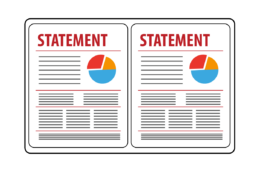
Rubika™ is able to adjust the layout of the output data so it is formatted in "2-up" fashion, where two logical sheets are arranged to print on one larger physical sheet. For instance, you might render US Letter and A4 documents in a 2-up scheme on US Ledger or A3 media, respectively.
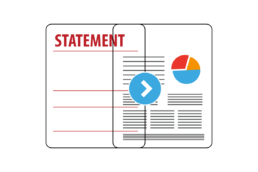
The 2-Up step can arrange the sheets in the input data (also referred to as "sheetlets") on the larger output media using two different methods: Sequential and Stacked.

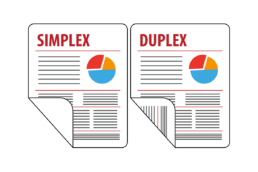
  • Sequential - The 2-Up step arranges the input sheets on the output media so that the left side of the front is an odd sheetlet number and the right side of the front is the next even sheetlet number. The back side of the output sheet is set up to match appropriately: if the input data is duplex, the original duplexing is reproduced; if the input data is simplex, the back side of the output sheet will be blank.
  • Stacked - The 2-Up step arranges the input sheets on the output media so that the stack of input sheets is divided by two. Sheets 1 through n/2 render on the left side of the output stack and sheets (n/2)+1 through n render on the right side of the output stack, where n is the total number of sheets to be presented in 2-up fashion. The back side of the output sheet is set up to match the original plex of the input data.
  • Output is typically formatted as 2-Up to accommodate printer and finishing equipment requirements.
  • Formatting output as 2-Up on larger paper can also be used as a way to reduce printer click charges and paper usage.

 
Get Solimar News When and How You Want It!
Enter your business email address and start receiving information about Solimar news, special educational events, and product updates. Join Today!
Business Email Address: