
The In-Bound Mailroom Automation Opportunity – From Paper to Digital in 5 Easy Steps
Skilled patient services professionals chose their careers to support people — to guide patients through enrollment processes, ensure consent is properly documented, and keep healthcare running smoothly for the people who depend on it. What they didn’t sign up for is spending their mornings sorting through stacks of physical mail.
The good news is they no longer have to. As medical services organizations modernize their in-bound document workflows, a well-designed digital mailroom doesn’t just solve a logistics problem — it gives highly trained staff their time back. The same professionals who were manually handling, sorting, and filing paper documents can instead focus on the patient-facing work for which they were hired. The documents still arrive. The compliance obligations are still met. But the manual burden in between disappears.
For organizations managing between 100 to 600 or more pieces of inbound physical mail daily — patient enrollment applications, consent forms, PHI-containing correspondence — across multiple facilities and increasingly remote teams, the path forward is clear, proven, and well within reach.
Why In-bound Mail Is a Different Kind of Challenge
Most digital transformation conversations in healthcare focus on outbound communications: statements, benefit explanations, care instructions, and appointment reminders. The technology ecosystem for that direction of flow is mature and well-understood.
Inbound mail is harder. Patient enrollment applications, consent forms, and PHI-containing correspondence arrive in physical envelopes, on their own schedule, in volumes that can swing from 100 to more than 600 pieces in a single day, depending on season, campaign activity, or enrollment cycles. Each document carries compliance obligations the moment it enters the building — and those obligations don’t pause while a document sits in a sorting tray waiting for a staff member to process it.
For organizations that have moved patient services teams to remote operations, the challenge compounds. The mail still arrives at a physical facility. The staff who need to act on it may be anywhere. This is the problem worth solving — and it is entirely solvable with the right workflow architecture.
What a Well-Designed Digital Mailroom Actually Looks Like
The goal isn’t simply to scan paper and store files. The goal is to create a secure, auditable, end-to-end process that converts physical documents into actionable intelligence — indexed, searchable, archived, and delivered to the right people without creating new compliance risks.
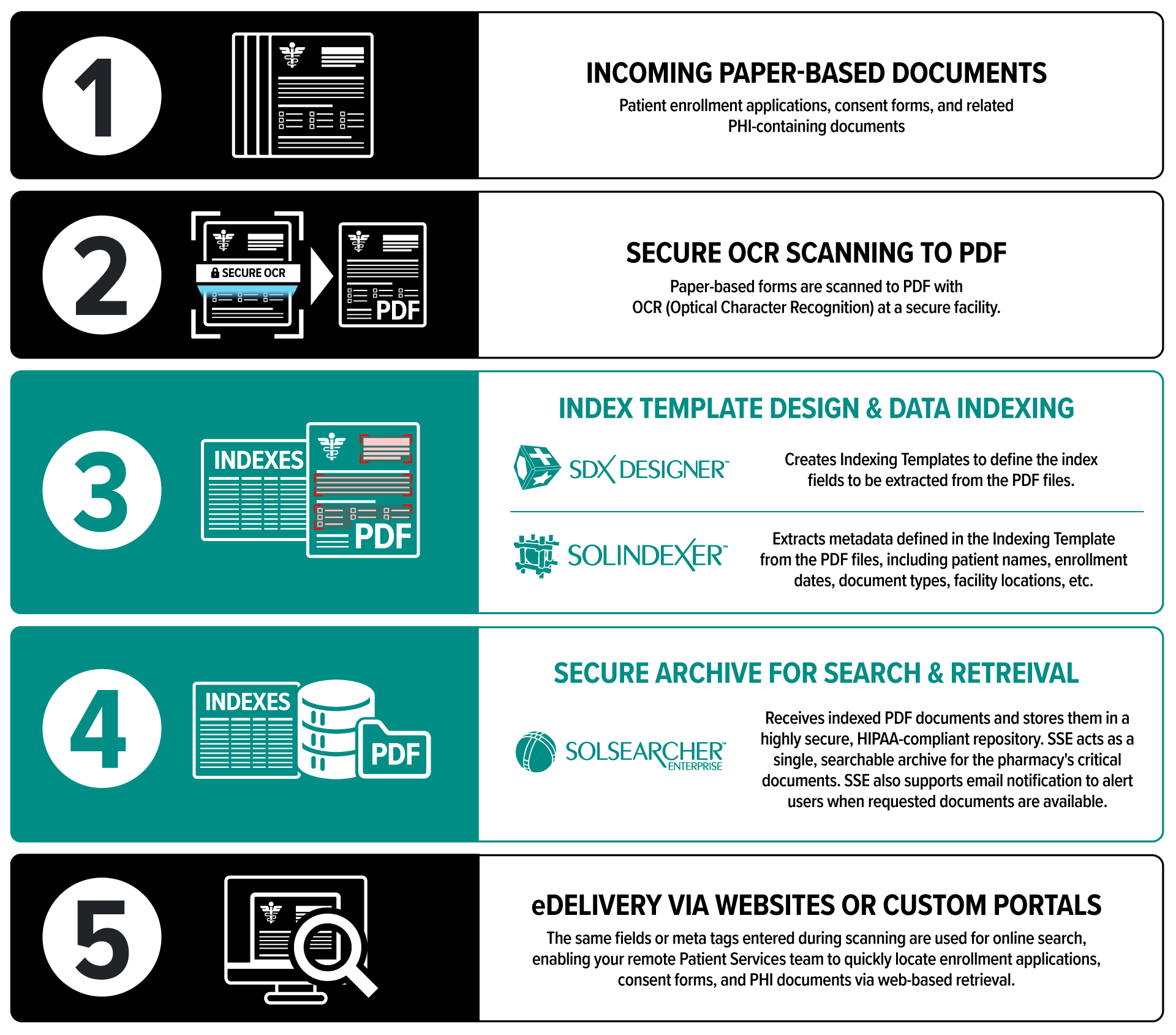
The Solimar Chemistry Platform is built precisely for this kind of orchestration. Rather than a single product, it brings the right components together into a coordinated workflow. For inbound mail, the workflow has five distinct stages — each dependent on the last and designed to be consistent regardless of daily volume.
Stage 1: Secure Document Intake
Consistency begins at the point of capture. Patient enrollment applications, consent forms, and related PHI documents are received at a secure facility, where chain-of-custody procedures lay the foundation for all downstream activities.
Stage 2: OCR Scanning to Searchable PDF
Documents are scanned to PDF with OCR (Optical Character Recognition), converting physical paper into machine-readable digital files. This isn’t simply a digitization step — it’s the essential prerequisite for every intelligent process that follows. Without accurate, searchable PDF output, indexing and classification might be limited to file names and metatags and may not function reliably.
Stage 3: Intelligent Indexing with SDX Designer and SOLindexer
This is where workflow intelligence is introduced. SDX Designer, Solimar’s Acrobat plugin, allows organizations to create Indexing Templates that define exactly which data fields should be extracted from each document type — patient names, enrollment dates, document classifications, facility locations, and more. SOLindexer then executes that extraction automatically against each scanned PDF, eliminating manual data entry and ensuring every document arrives in the archive pre-tagged, pre-classified, and search-ready. The template-driven approach means the process is deterministic — the same fields are captured the same way, every time, regardless of volume.
Stage 4: HIPAA-Compliant Archive and Retrieval
SOLsearcher Enterprise (SSE) ingests the indexed documents and stores them in a highly secure, HIPAA-compliant repository — a linkable, searchable archive for all critical inbound documents. SSE also supports email notification, alerting users when specific requested documents become available. For remote teams operating across shifts or time zones, that notification capability is operationally significant.
Stage 5: Secure eDelivery to Remote Teams
The metadata captured during indexing becomes the search infrastructure for front-end retrieval. Remote Patient Services staff can locate enrollment applications, consent forms, and PHI documents via web-based search — without VPN file shares, without emailing sensitive content, and without the compliance exposure those approaches create. Role-appropriate access means the right people see the right documents, and the audit trail is intact throughout.
Designing for Volume Variability
One factor that makes inbound mail genuinely difficult to manage is unpredictability. A workflow designed around average daily volume will strain under peak conditions. A workflow designed around peak volume will be inefficient on light days.
Intelligent batching addresses this directly. SOLitrack’s batching module combines work by product type and SLA due dates, with configurable rules that control page counts, impressions, and whether batch release is automated or manually triggered. Every job within each batch is tracked through its lifecycle.
For organizations that need to go further — optimizing the physical production of batched output — Rubika’s Assembly module handles the PDF re-engineering required to combine batched jobs into optimized production files. Resource caching significantly reduces file sizes; barcodes and control marks support post-press handling; content adjustments ensure compatibility with standard output profiles. Paired with SOLfusion for scheduling, the entire batching cycle can be automated — accumulate, optimize, release — without manual intervention.
The PHI Protection Layer
For many organizations, the indexing and retrieval workflow addresses the operational challenge. But some downstream routing scenarios introduce an additional requirement: stripping PHI from documents before they move to external partners, secondary systems, or less-secure environments. Solimar’s redaction capabilities are purpose-built for this. Sensitive data is permanently removed from documents while maintaining integrity — adding a further layer of protection for organizations whose workflows cross organizational boundaries.
Healthcare at Scale: What’s Already Been Proven
The components described here aren’t theoretical — they’re in production across healthcare organizations today. When Mayo Clinic needed to move from manual kitting and mailing of personalized patient booklets to an automated in-house production workflow, Solimar’s platform enabled it. The result eliminated manual processes, ensured current material versioning for every patient, and freed nursing staff from document handling entirely — earning the 2023 Xplor Application of the Year Award in recognition of what such a workflow transformation means for patient care.
At a different scale, the Chemistry Platform enabled IWCO Mail-Gard to triple healthcare communications capacity while maintaining 100% disaster recovery success — a proof point for organizations where both volume and continuity are non-negotiable.
The Bigger Picture
The inbound digital mailroom isn’t a niche problem. It’s a crossroads that nearly every healthcare organization managing physical patient correspondence will eventually face — and the organizations that approach it with the right architecture from the start will be better positioned for compliance, scalability, and the operational demands of a workforce that is increasingly remote, distributed, and time-sensitive. More importantly, it’s an opportunity to put skilled people back where they belong: working with patients, not paper.
The Solimar Chemistry Platform is designed for exactly that intersection — the point where document complexity meets operational reality, and where the right workflow architecture makes all the difference.