



Hansen Longfellow, Print & Mail Workflow Expert
Hansen360 Inc.
hansen360.com
Going 6x9 — The Intelligent & AI Way
In print and mail production, complexity adds up fast. Multiple applications, various envelope formats, tight SLAs — every variable on the floor is just one more thing to plan, stage, and double-check. The leaders running the most efficient mail factories know that simplifying and streamlining, not heroic last-minute efforts, are what really drive results.
A growing print service provider recently decided to standardize. Their shop was juggling jobs for both #10 and 6”x9” envelopes across several applications. The opportunity was obvious: moving everything to a single 6×9 large-window envelope would tidy up inventory, reduce equipment changeovers, speed up setup, and make onboarding new work much easier. One envelope, one stocking strategy, one clear standard for the team.
There was just one hurdle to clear — and it was more about trust than technology.
“We seek out commonality to create workflows that maximize throughput. 40+ applications became one repeatable process. Challenging and satisfying, we can see the direct impact on throughput and process optimization with Solimar tools.” Hansen Longfellow, President/CEO of Hansen360, an authorized Solimar Professional Services Provider.
The 6”x9” window challenge
The problem is that a 6”x9” window is much larger than a #10. While that extra space is fantastic for showing off branding or making barcodes easier to scan, it also means more of your document is visible. If you have an application originally designed for a #10 envelope, you run into a real privacy risk: sensitive information that used to stay hidden behind the paper might now be sitting right there in the window for everyone to see.
Trying to manually check every single document for these privacy leaks is a nightmare. It might work if you only have a few jobs, but it’s impossible at a production scale. This “validation tax”—the time and effort needed just to make sure things are safe—is exactly why many shops keep using two different envelopes, even when they’d much rather just stick to one.
Pairing AI inspection with Rubika automation
To move toward a single-envelope standard, the team brought together two powerful tools that work hand in hand.
First, they used a machine learning model to scan through sample documents. It was trained to look specifically at the envelope window area and flag any pages where sensitive data might be peeking through. Instead of asking employees to squint at thousands of pages, the AI did the heavy lifting, pointing out exactly where a human eye needed to double-check.
That’s where Solimar’s Rubika stepped in to fix things automatically. Whenever the AI found a potential privacy issue, a Rubika workflow instantly created a new address slip. By moving the address to a controlled insert page, the team ensured the envelope window showed only what it was supposed to. This meant no one had to redesign the original applications or rewrite any code—the PDF goes in messy and comes out perfectly safe for the mail.
“This same combination of AI and Rubika works for every new application that comes through the door. What used to take weeks of manual set-up is now just a standard, routine part of onboarding,” states Deepak Goyal, Hansen360 Chief Architect & CEO.
This is exactly what Rubika is made for: taking smart, page-by-page decisions and applying them at scale without ever slowing down the production line.
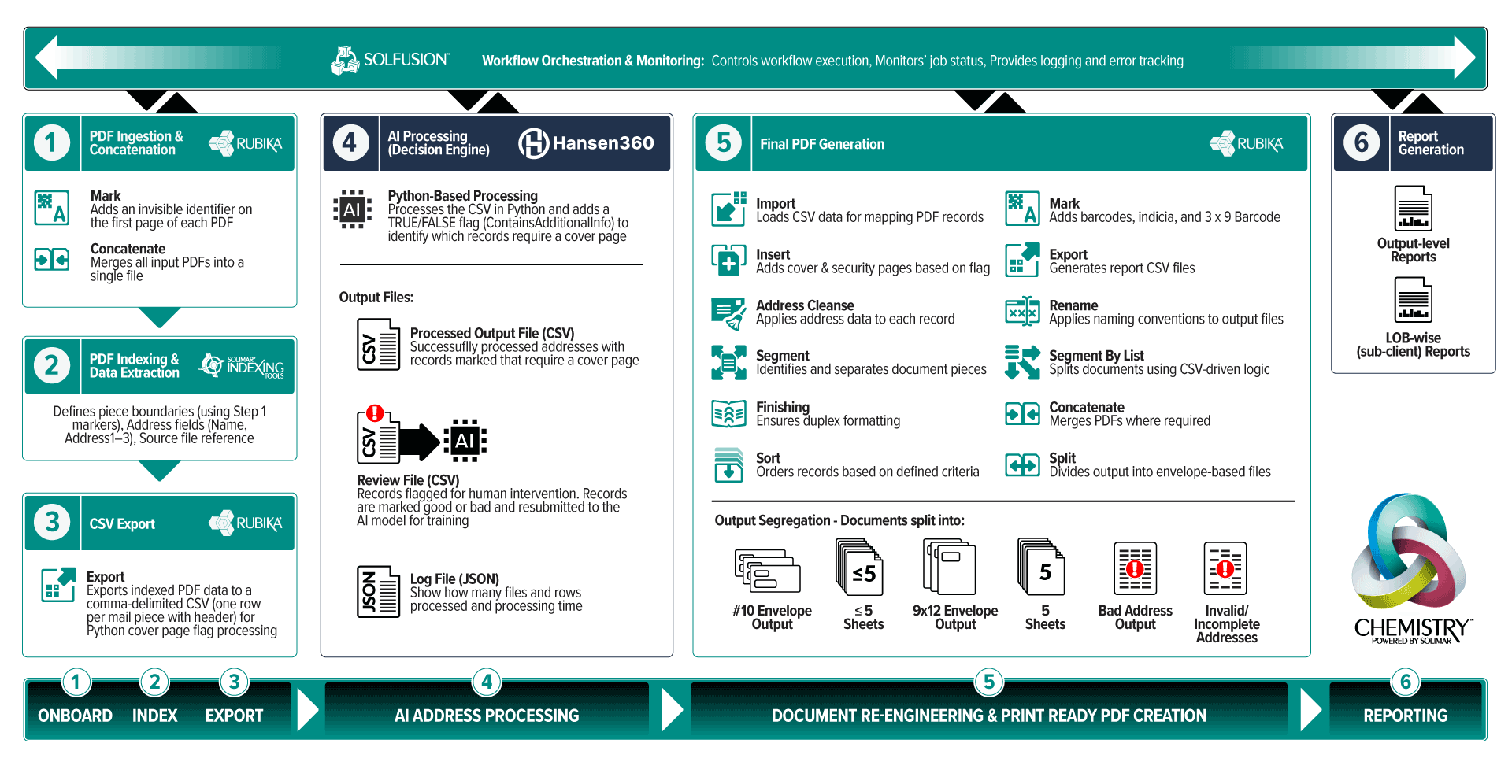
Anchored in the Chemistry Platform
Rubika doesn’t just sit on a shelf. It thrives as a core piece of the Solimar Chemistry® Platform. Think of this platform as an integrated ecosystem that ties together everything from design and optimization to tracking and delivery. It creates a smooth, coordinated workflow where everything talks to each other. Once the team saw how well the AI and Rubika worked together on one job, moving that success to the next project — and the one after that — became a simple tweak rather than a major undertaking.
The whole journey was mapped out by Hansen360, Solimar’s trusted consulting and integration partner. Their experts are masters at turning high-level business goals into practical, everyday reality. They didn’t just set up the tech; they built workflows that the operations team can truly own and run with confidence day in and day out.
“Our client had SLAs they couldn’t compromise on. The moment we paired the mailing list detection layer with Solimar’s post-composition capability, we had a path that was both fast and defensible from a privacy standpoint. That combination is hard to beat,” states Longfellow.
Outcomes that compound
This print service provider is now fully standardized on 6×9 envelopes. Making that switch didn’t just tidy up the warehouse; it completely changed how the floor operates. Here is what that looks like in practice:
- Everything runs through one single envelope format.
- No more juggling different stock or dealing with dual-envelope headaches on the floor.
- New jobs get up and running much faster than before.
- Quality control is a breeze because AI flags only the specific pages that actually need a human look.
- Inserters are running more efficiently with higher throughput.
- Mail hits the delivery stream sooner.
- Shift changes are smoother because there is less friction and fewer variables to hand over.
But the real win is having a repeatable blueprint. This same combination of AI and Rubika works for every new application that comes through the door. What used to take weeks of manual checking is now just a standard, routine part of onboarding.
Where AI becomes practical
We often hear about AI in manufacturing through the lens of what it might replace. But the more compelling story is about what AI quietly enables: the kind of operational standards that used to feel too risky or labor-intensive to even try.
Moving to 6×9 envelopes wasn’t just an “AI project.” It was an operations project where AI played a specific, helpful role: it flagged the tricky cases that needed a human eye, and then let Rubika apply that human logic consistently across the entire production line.
“I’ve been in this business long enough to understand the value of a white paper solution. We’ve seen it work at a small scale, but the AI layer is what finally made true scalability possible. We have real confidence in the results across the full volume,” states Goyal.
This is intelligent automation at its best—clearing away the hurdles that keep good ideas on the shelf and giving teams the confidence to finally make the big moves they’ve been planning.

Ready to discuss your needs and questions?
Let’s have a SOLichat!
Ping us at SOLichat@solimarsystems.com
For more information, call the Solimar Sales Team at +1.619.849.2800.