

Business Profile
OSG is a customer communications management provider delivering multi-channel communications across print, mail, digital, and payment channels for regulated industries. With more than 50 years of experience, OSG serves over 4,400 clients from 10 production facilities nationwide.
Industry
Service Bureau & Outsourcing
Two Decades, One Partnership: How OSG and Solimar Systems Built a Leading eDelivery and Archive Solution
Introduction
Ask most software companies for a customer reference, and you get a project. Ask Solimar Systems about OSG, and you get a working relationship measured in decades. OSG — previously NCP Solutions — has worked with Solimar Systems for over 20 years, through acquisitions, platform migrations, and a complete rebuild of the company’s electronic document archiving and delivery. At the center of that work sits Atlantis, OSG’s imaging network system, with SOLsearcher™ Enterprise (SSE) as its electronic document repository and retrieval engine.
OSG has sat on the Solimar Systems Customer Advisory Council since its inception, and the company continues to use that seat. The Council comprises over companies and nearly 100 individual members, and it is where customer requirements become roadmap items. Both Tim Cooper, OSG’s Chief Architect, and Daniel Durie, its Chief Technology Officer, are active contributors.
Several SSE capabilities exist today because OSG requested them. Hierarchical Storage Management (HSM) was added to the product on OSG’s recommendation. Flate compression was added to bring down delivery times when serving extremely large files. Configurable modules on output servers — the mechanism OSG now uses to scale retrieval — emerged from the same conversations.
“Solimar Systems is a great partner and helped us work through many details,” says Tim Cooper. Daniel Durie puts it in the present tense: “There have been different bottlenecks at different times, and we’ve worked with the Solimar Systems technical team to address and overcome all of them.”
Why OSG Went Looking
The short version of the backstory: by 2009, the legacy imaging platform inherited from NCP’s Jacksonville operation could no longer keep up. Retrieval had stretched to between four and ten seconds. Every new client meant 24 to 60 hours of custom programming. Billing was manual, and there was no path to scale a business growing both organically and by acquisition. “Four to ten seconds to open a PDF file can feel like an eternity when you’re on a website,” says Cooper.
Research in 2010 confirmed no off-the-shelf system would do the job, so OSG built one. During a design session in Jacksonville, Space Shuttle Atlantis lifted off, the project acquired a code name, and — as often happens — the code name stuck. SSE was written into the core design as the image repository. The build began in autumn 2011; Atlantis went into production in April of 2013.
Every goal OSG set for the project — accuracy, delivery, audit, automated billing, performance and scalability, configurable setup without programming, and real-time monitoring — was met. “We were able to solve all of these issues with our Atlantis system using Solimar Systems as the back-end technology solution,” says Cooper. That is where most case studies stop. It is where this one starts.
At-A-Glance
Locations (USA)
- Carol Stream, IL (HQ) · Carlstadt, NJ · West Chester, PA · Mount Airy, NC · Clearwater, FL · Milwaukee, WI · Bloomington, MN · Tempe, AZ · Avondale, AZ · Lake Forest, CA
Business Solution
- ecure Document Archiving and eDelivery
- Electronic Document Presentment
- Hierarchical Storage Management
- Review and Release / Proofs and Approvals
- Document Re-engineering
- Data Stream Transformation
- Data Indexing
Solimar Products
- SOLsearcher™ Enterprise (SSE)
- Solimar® Print Director™ Enterprise (SPDE)
- SOLfusion™
- Rubika®
- Solimar® Indexing Tools
Benefits
- Massive processing scale: 34.9 million documents and 80.4 million images archived daily
- Rapid availability: 550,000 documents processed, loaded, and online within six hours
- Fast document retrieval: 48% served in under 0.5 seconds, 71% in under 1 second, and 96% within 3.5 seconds
- Cost-efficient storage: Automated migration from solid-state storage to virtual tape as documents age
- Flexible, long-term retention: Configurable retention from short reprint windows to 30-year archives, with tier thresholds and deletion dates
- Simplified growth and onboarding: Configuration replaces custom programming, with scale-out achieved by adding server modules
Built Because OSG Asked
Hierarchical Storage Management (HSM)
OSG needed documents to automatically move to less expensive storage as they aged, without changing how users find them. “We built Hierarchical Storage Management into SSE per OSG’s recommendation,” Mary Ann Rowan, Chief Experience Officer at Solimar Systems. Newest work lands on the fastest storage; older work dynamically migrates through progressively slower and less expensive tiers; documents are automatically deleted when the agreed-upon retention date arrives. “It’s totally blind to the user,” Rowan notes. “They have no idea what storage system they’re going to get it from. It might take half a second longer; it may not.” HSM is core to SSE, and all customers can benefit from this functionality.
File compression
Print wants CMYK and high resolution. Archive does not. OSG and Solimar Systems worked through color space and resolution together, then kept going. “We were sweating every kilobyte in the PDF,” Cooper recalls. “That’s when Solimar Systems implemented flate compression for us.” At 80 million images a day, where images rather than documents consume capacity, those kilobytes compound.
Archive structure tuned for query performance
“On the database side, that’s something we’ve spent a lot of time with Solimar Systems on as well,” says Durie, “making sure we have archives structured so that when a client logs in, they’re not searching a greater amount of data than needs to be searched.”
Configurable modules on output servers
This is the capability Daniel Durie singles out when asked how OSG keeps retrieval fast as volume grows. “One of the great features of SSE is that we can configure modules on output servers. That’s one of the ways we’ve been able to scale — to add servers over time and control how those are managed.”
Retention, Tiering and the Shape of Access
The most useful thing OSG has learned about archives is that documents are not equally interesting over time.
Across nearly every vertical, access concentrates in the first 30 to 90 days — a consumer questions a charge, a service representative pulls a statement, a client requests a reprint. After that, activity falls away sharply, even though the retention obligation may run for years. In mortgage servicing, it can run for the life of a loan: up to 30 years.
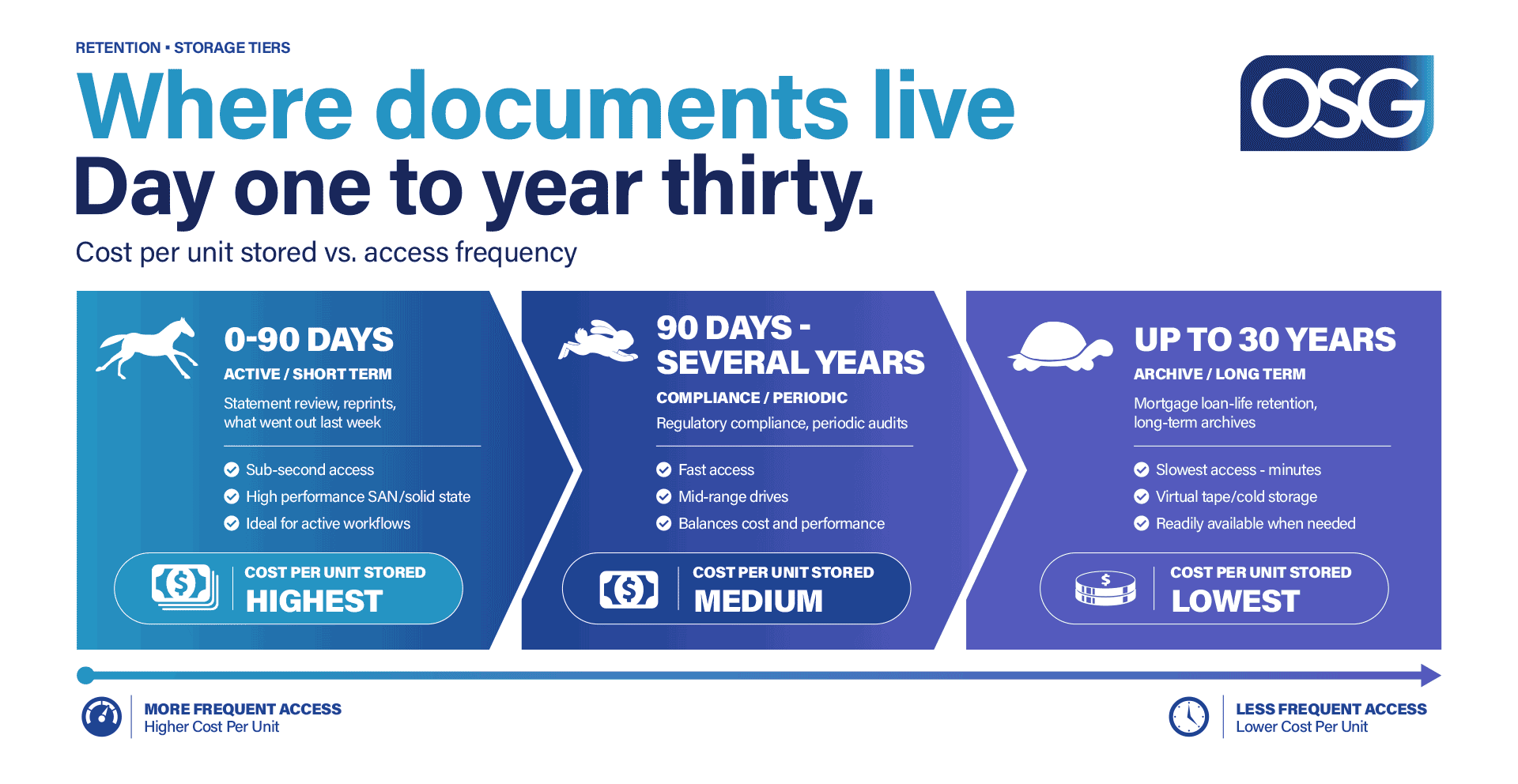
”Even on the mortgage side, tiered storage is critical,” says Cooper, “because in reality most of the access across all of the markets is going to occur in the first 60 to 90 days. And then you can move that to lower-cost, slower-performing storage.”
Durie frames the economics directly. “The easiest thing would be to put everything on the fastest storage, everything on a tiny database table. But we have customers who want to keep things for the life of a loan, and it’s much less common that someone’s going to look at something from 12 years ago.”
Retention periods themselves are configuration, not code. SSEs are deleted automatically when the agreed timeframe is reached, and adjusting them — for a project, an audit, a business event — is a routine client conversation rather than a development request.
Retrieval Speed, Then and Now
Direct Access is OSG’s branded retrieval service, embedded in client websites so that end consumers can access the Atlantis SSE-based archive without ever leaving the brand they are dealing with.
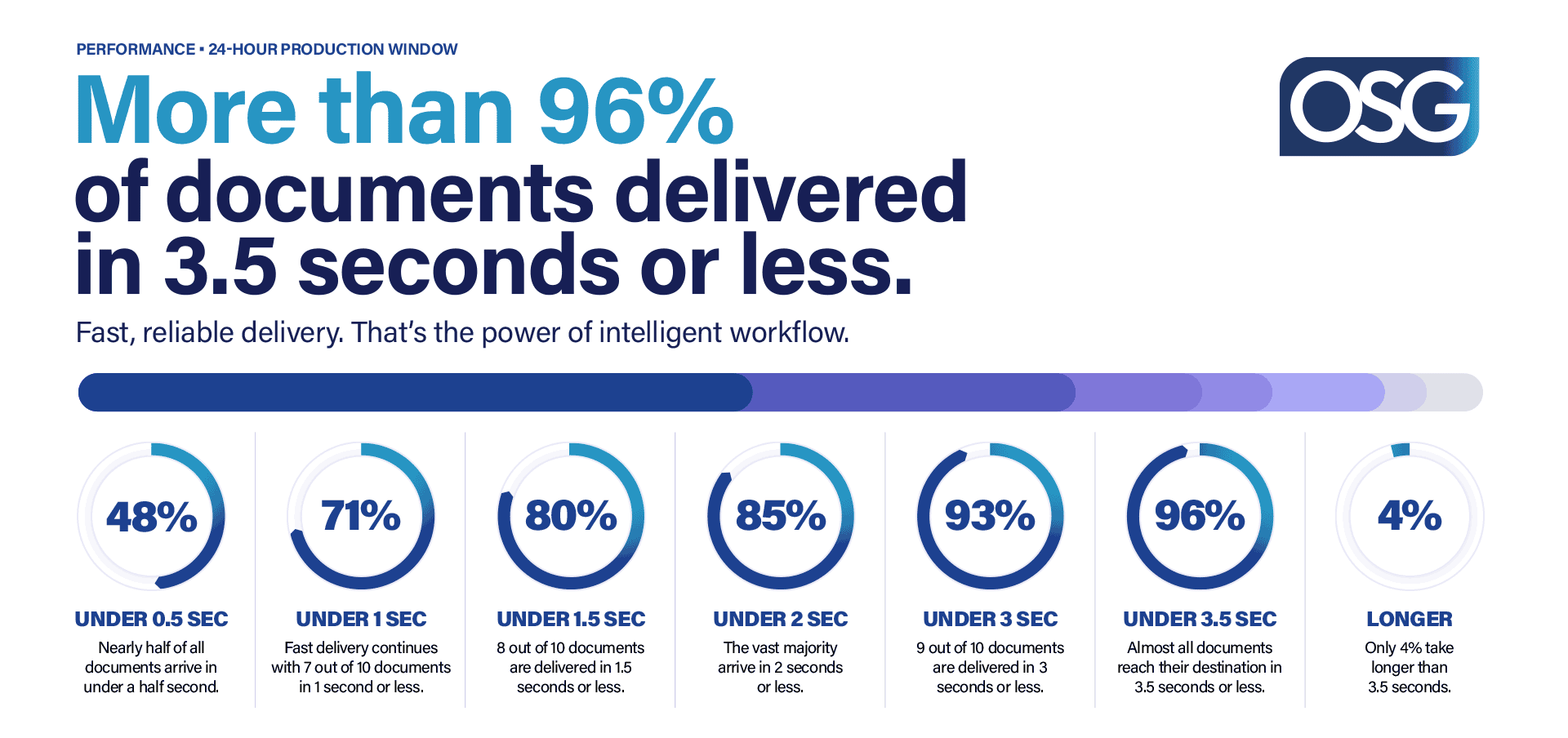
“That’s just phenomenal, and I would argue it’s still industry-leading today,” says Cooper. The longer tail belongs to multi-page documents — some 40 or 50 pages, occasionally more than a thousand images.
Scale sits behind the speed. The Atlantis dashboard reports 34.9 million documents and 80.4 million images per day, at roughly 3.35 million images per hour. One of OSG’s tightest SLAs requires that 550,000 documents be received, processed, loaded, and made available online within six hours.
Configuration Instead of Code
The change OSG’s own team notices most is what no longer happens.
Under the legacy system, almost every client arrived with specific requirements — index method, PDF naming convention, multi-document versus single-document PDFs, delivery bundling — and each one meant a developer. Today, all of it is configuration inside the Atlantis output and FTP engines, built on SSE’s archive structure. Flex fields handle delivery bundling, where a job that runs as a single job in production needs to reach the client as several jobs. Archive segregation keeps client data separate and, increasingly, keeps departments within a single client separate to prevent fraud.
“I don’t think we’ve had to make a code change to support a client-specific request in many years,” says Durie. “I say that as someone whose background way back in the day was a developer — but it’s great when you don’t have to write code to meet a customer request.”
Onboarding tells the same story. Asked how long it now takes to bring a new client into Atlantis, Durie’s answer surprised the room: “The actual configuration of it, I’d imagine that’s a couple of days, tops. The actual hands-on keyboard, it’s very, very fast.”
Where the System Is Today
Thirteen years after Atlantis went live, the requirements have changed considerably, and OSG has met them from the same foundation, extending rather than replacing.
Digital delivery is now table stakes
“Digital delivery is required. On every RFP that we’re doing, it’s required,” says Durie. “The expectation on how long it takes something to process has come down across the board, but where you see that most is digital delivery. They’d like to send a file overnight, and the digital images are ready in the morning — which is vastly different from when we were implementing Atlantis originally.”
Onboarding speed has become a sales argument
“We’re always pushed on how we can onboard faster. It’s been great from the perspective of Atlantis to say, well, we know this piece isn’t going to take a long time. That’s a huge advantage of this platform.”
Review and release has evolved
OSG’s proofs-and-approvals workflow lets clients inspect a job in the archive before it prints. It used to require the client to nominate specific documents in advance. “More clients don’t want to be tied down to doing that,” says Durie. “They’d rather look at the whole file and choose whatever accounts they want. We’ve accomplished that by indexing it so you can search anything on the document in advance of the approval for printing.” That change is recent, and it was possible because the indexing capability was already there.
Mixed input formats keep arriving
OSG’s coupon system still produces Metacode, and clients still send AFP. Solimar Print Director Enterprise and Rubika transform them into indexed PDFs for SSE — and clients increasingly ask for the digital image to be improved or enhanced after the fact, which post-composition is built to do.
Segregation requirements keep tightening
Multiple archives for a single client, departmental access restrictions, and fraud-prevention boundaries within one organization. “That’s a more and more common ask,” says Durie.
The same architecture now underpins newer Solimar Systems capabilities. SSE is the back end for piece-level tracking, and SOLsearcher™ Cloud extends the same model as a cloud-native service on Azure — evidence that the platform OSG helped shape in 2011 is still where new development happens.
The Chemistry® Platform Solution

SOLsearcher™ Enterprise (SSE)
Highly secure electronic document delivery and web presentment solution that enables organizations to effectively index, store, search, and retrieve large collections of transactional documents, with hierarchical storage management and scalable server modules.

Solimar® Print Director™ Enterprise (SPDE)
Output management solution combining integrated connectivity with fast, accurate print stream conversions and job routing & tracking capabilities.

SOLfusion™
Automates output production tasks such as external processes & scripts, indexing PDF documents, and executing Rubika® configurations.

Rubika®
Post-composition re-engineering solution to automate manual processes, enable postal savings, add value to documents, and modifies print data.

Solimar® Indexing Tools
Powerful PDF indexing tools to design, test and manage indexing templates for data extraction.
Still Building Together
There is a version of this story where a customer buys a product, deploys it, and both parties move on. That is not what happened here. OSG brought hard problems — 80 million images a day, six-hour SLAs, mortgage retention measured in decades, and clients who each want their data delivered differently. Solimar Systems built capabilities to meet them, and those capabilities became part of the product for everyone. OSG gained a system that has not needed a code change for a client request in years. Every other Solimar Systems customer got Hierarchical Storage Management, Flate compression, and a scale-out model that adds servers instead of complexity. That exchange is still running. It runs through the Solimar Customer Advisory Council, through the questions OSG’s clients ask on RFPs, and through the next set of expectations that will arrive before anyone has finished meeting the current ones.